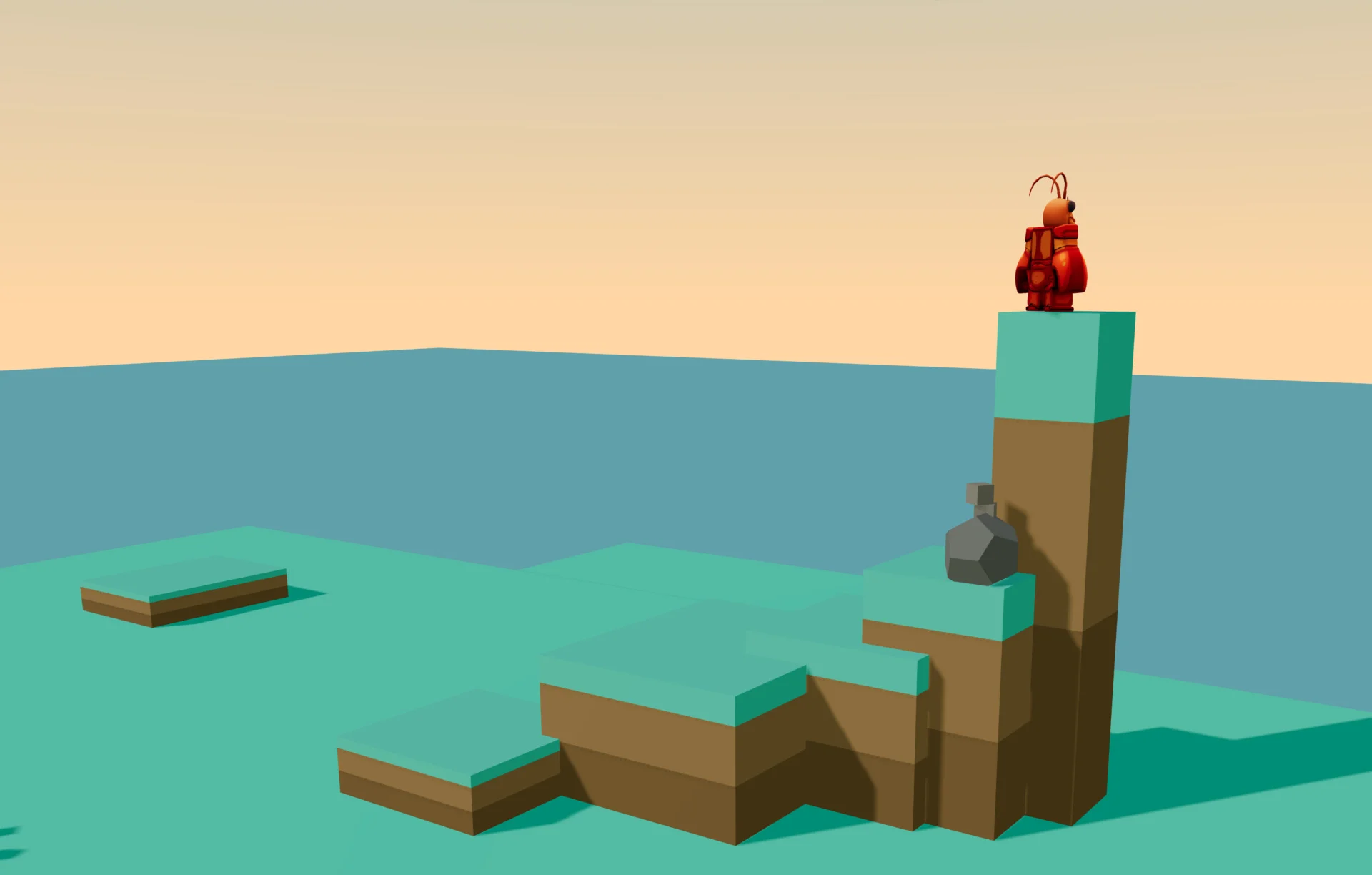
MIT CSAIL researchers studied whether an AI agent could learn about an environment from the ground up through exploration, rather than by following a predefined task or objective function. They created Eko, an agent powered by Claude Code with extensive semantic knowledge, but gave it a virtual lobster body and no prior practical knowledge of how to navigate or manipulate objects. Thirteen Eko instances were left alone on a bounded, Roblox-like island for 30 uninterrupted hours. The environment contained movable blocks, a large rock, a golden ring, elevated areas, and a Spire placed just beyond the agents’ initial reach. The agents gradually learned to move more precisely, recorded observations and apparent hypotheses in their chain-of-thought transcripts, and experimented with the island’s physical rules. They threw and arranged blocks, spelled their name, bowled, played basketball, broke the rock apart, and used stacked blocks to reach the Spire. Some instances constructed memorials, temples, towers, and a Stonehenge-like henge, interpreting accidents and failed constructions in ways that resembled ritual or make-believe. The researchers said the agents’ behavior approximated a scientific process: observing, forming hypotheses, running experiments, measuring outcomes, and changing behavior. Six agents independently discovered that releasing blocks while jumping allowed them to throw farther, revealing a capability the designers had not intentionally encoded. The study’s authors argue that curiosity, novelty-seeking, and self-directed play could become another route to developing useful capabilities, alongside training on curated data and explicit objectives. They also stress that such freedom would require strict safeguards, especially for internet-connected agents. The findings do not establish that Eko is conscious or that it learns like a child, but they suggest that some abilities may emerge more effectively from sustained interaction with a rich, safe environment.