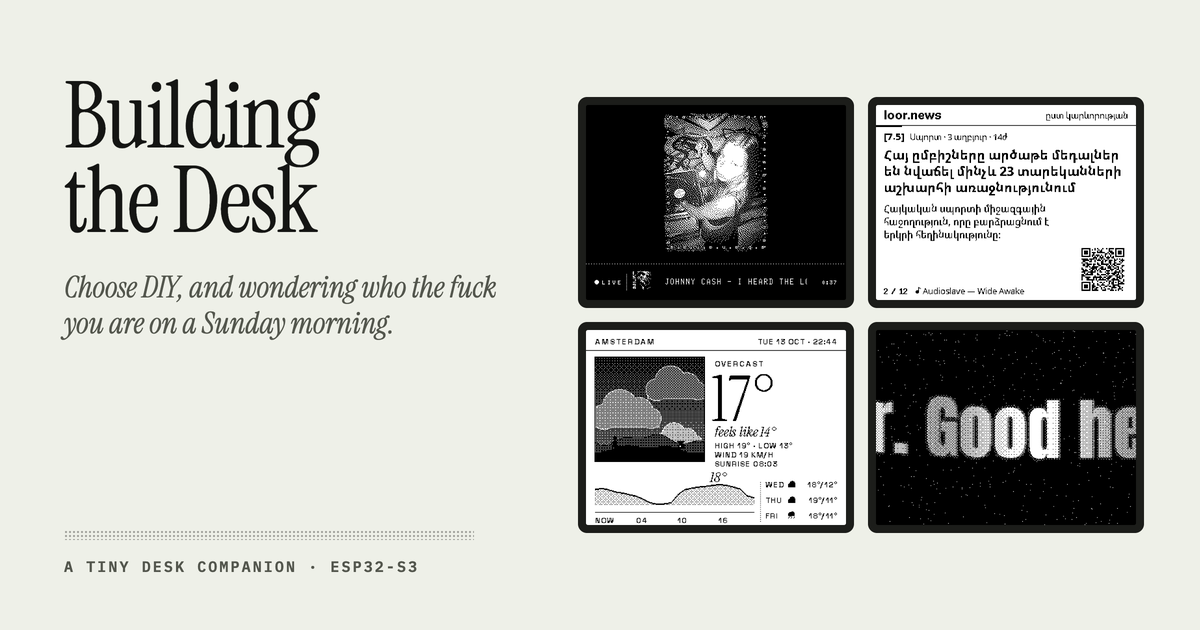
The author describes building a small desk companion around Waveshare’s ESP32-S3-RLCD-4.2 board, using Claude and Claude Code as collaborators while retaining human direction and review. The device combines a 400×300 reflective display, synchronized internet radio, Armenian news, weather graphics, a clock, room sensors and a spoken scrolling-art screen. Its firmware is written in C++ with Espressif’s ESP-IDF rather than Arduino, and a locally served `desk.local` web app lets a phone control the device without cloud services. The radio had to reproduce the website’s Mulberry32-style shuffle exactly; a Node-versus-C++ test compared 6,288 cases, all of which matched. Memory pressure repeatedly exhausted the board’s 512 KB of internal RAM, so large data and network task stacks were moved into PSRAM. The build also addressed a disconnected speaker, reflective-display contrast, Armenian bitmap fonts, boot-time stack limits and gapless track changes. Performance work reduced the CHOOSE LIFE animation frame time from 28.6 ms to 9.8 ms, or about 36 frames per second, while free fast RAM rose from zero to roughly 45–55 KB. The author presents the project as a way to recover a sense of craft amid AI-driven changes to software work, and is considering future additions including NFC album cards and possibly running LLMs on similar small devices.