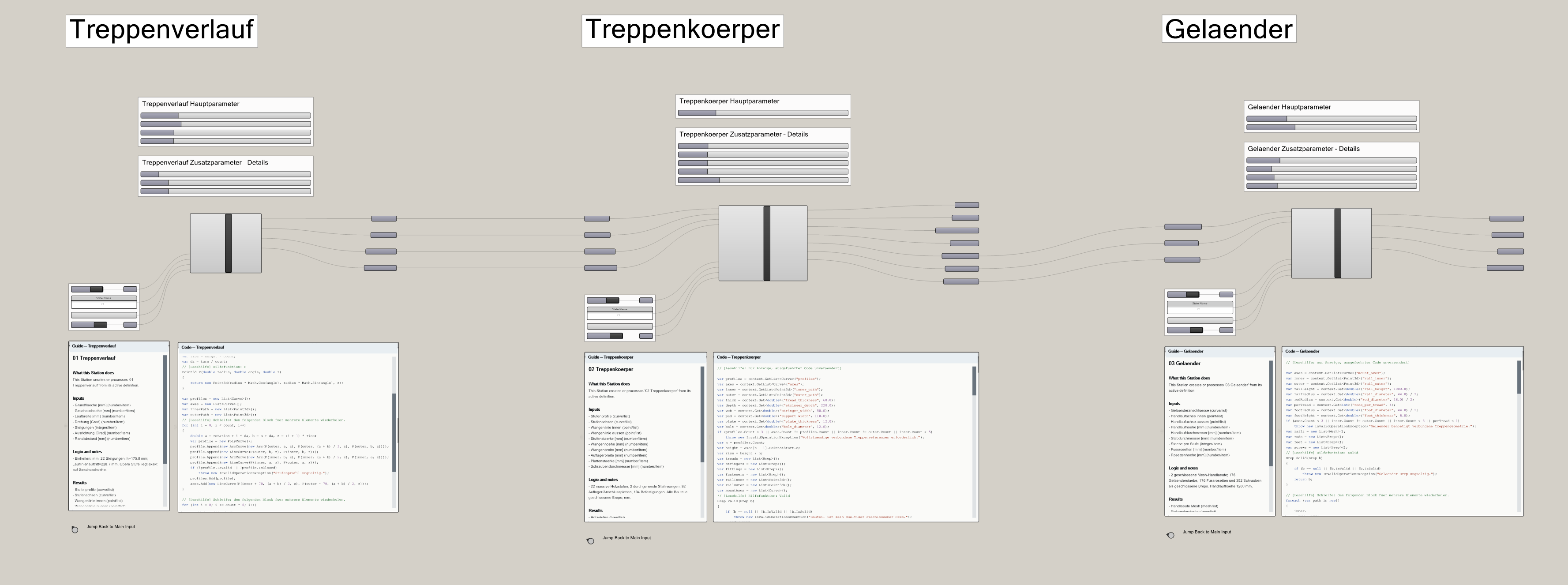
GrassLobster is a personal experimental prototype by Miro Bannwart that connects Rhino and Grasshopper with an external AI coding agent. Users describe a design idea, answer questions about dimensions, rules, materials, and adjustable parameters, and then review the agent’s progressively built parametric workflow. The geometry remains visible in Grasshopper through connected Geometry Stations, while the same logic, inputs, and project context are mirrored in readable files that the agent can inspect and modify. Supported values such as dimensions, counts, and spacing can be changed without rewriting Station code, allowing Grasshopper to recalculate related geometry. The setup can use references, screenshots, project folders, domain guidance, and Agent Instructions, but it is not an automatically indexed knowledge system; available context depends on the agent’s tools and file formats. The project is designed to work with interchangeable external agents rather than one built-in model, and a future optimization direction could let an agent vary inputs and compare measurable results, although no general-purpose optimizer is included. Bannwart reports better geometric results in development trials with GPT-6 Astra than with GPT-5.6 Sol, while local-model attempts have not succeeded, but he explicitly describes these as informal project observations rather than a controlled benchmark. GrassLobster 0.1.0-alpha is a free, proprietary-license Windows x64 package for Rhino 8, tested with Rhino/Grasshopper 8.30 and .NET 8; Rhino 7 and macOS are unsupported. Users must configure their own external agent, model, accounts, and tools, and should review generated geometry because successful calculation is not structural verification. The prototype remains unvalidated for general use, its APIs and project formats may change, and the author notes that clean-machine installation and client-specific integration checks are still outstanding.