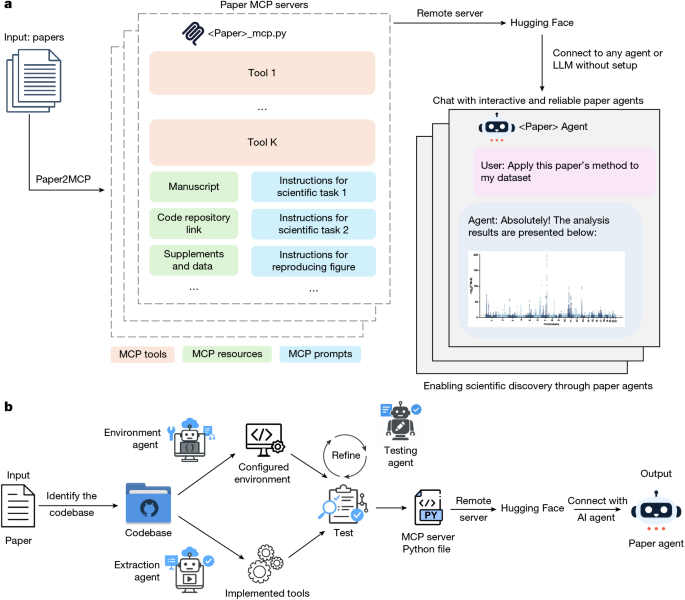
Nature researchers introduce Paper2Agent, a multi-agent framework that converts a research paper and its public codebase into an interactive AI agent. The system extracts methods and workflows, prepares an isolated environment, wraps reusable functions as Model Context Protocol (MCP) tools, and tests them against tutorial outputs before deployment. Manuscripts, supplementary materials, datasets, figures and code are exposed as structured resources, while MCP prompts encode multi-step workflows. In case studies, Paper2Agent generated 22 validated AlphaGenome tools in about 45 minutes for US$14 and seven validated Scanpy tools in about 45 minutes for US$13. The AlphaGenome agent reached 98.7% accuracy on tutorial queries, 100% on novel queries and 82.7% on open-ended researcher-style queries, outperforming the reported Claude-plus-repository and Biomni baselines; it also reduced runtime. The Scanpy agent reproduced key human-run preprocessing and clustering results across public single-cell datasets, and a TISSUE agent supported spatial transcriptomics analysis. In a larger evaluation, 74 of 100 computational-biology papers were successfully agentified, producing 593 validated tools from 599 proposals. Paper2Agent achieved 91.2% accuracy on 300 tutorial questions, while its resource layer reached 89.0% on synthesis questions from 26 data- and discovery-focused papers; it also generalized to 10 non-biology computational papers. Three collaborating agents combined AlphaGenome, CRISPR-interference and Perturb-seq evidence to prioritize GPR137 at a psoriasis locus, although the authors stress that the result remains a hypothesis requiring human assessment. The framework cannot reliably agentify every repository, and open-ended reasoning, security, intellectual-property issues and maintenance remain unresolved. The authors present paper agents as tools for access, reproducibility and collaboration, not autonomous or authoritative scientific decision-makers. The AlphaGenome agent and code are publicly available through Hugging Face and GitHub.