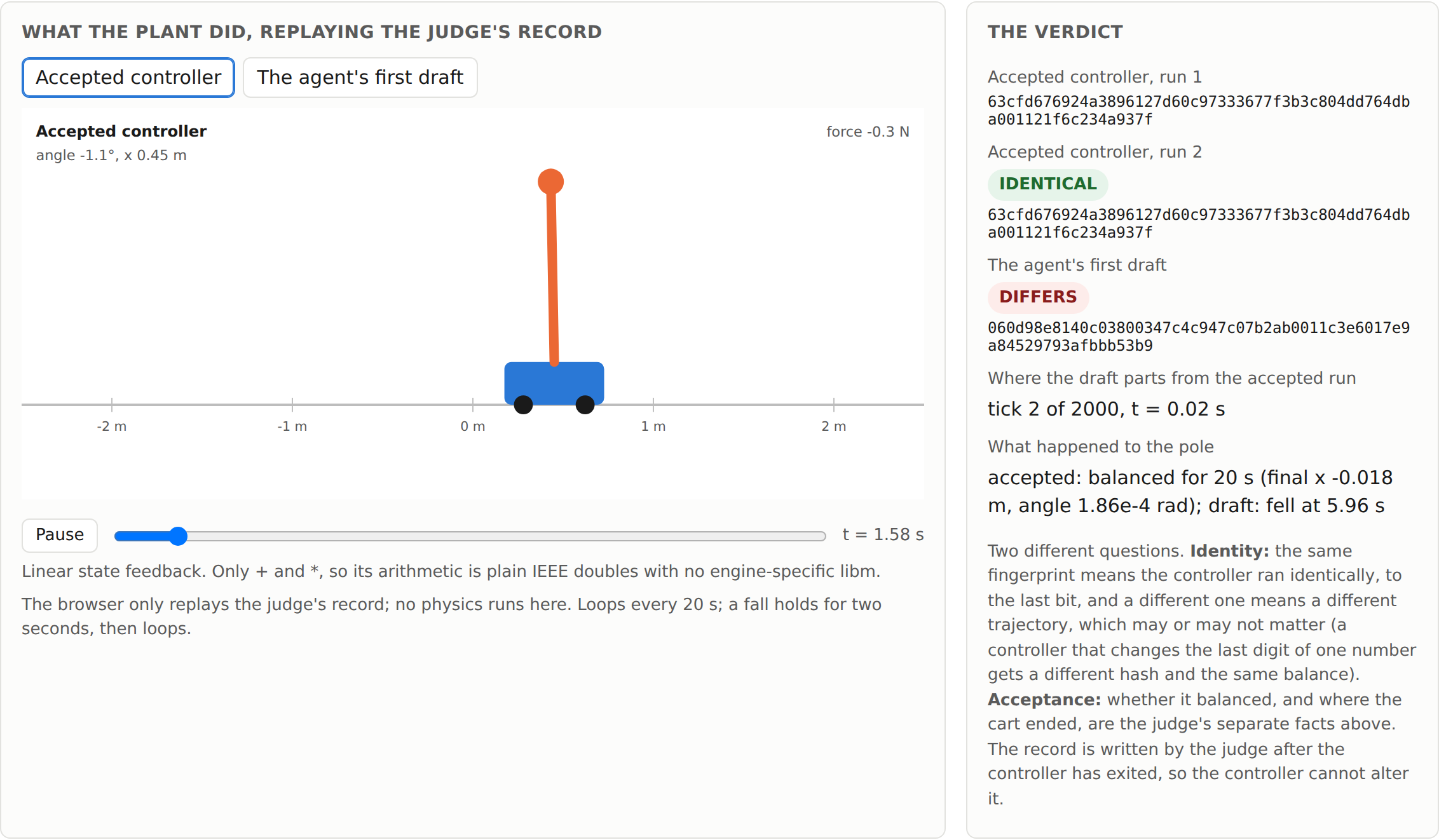
Plimsoll is a pre-1.0 Go sandbox service for running untrusted programs, including code written by AI agents, while reporting the isolation boundary actually used for each result. Providers are represented by four tiers, from process and container to kernel and VM; callers can set a minimum tier, and the daemon refuses to dispatch code when it cannot meet that floor. The official Go client checks the returned tier again, while result records include request and response SHA-256 hashes that clients can recompute. A separate attestation utility signs records, links calls into a chain, detects missing or altered entries, and replays runs, although the project explicitly says its tier evidence is not hardware-backed attestation. Plimsoll also evaluates agent-authored controllers against hidden scenarios in a simulation image. Its cart-pole example runs an accepted controller twice with matching trajectory fingerprints and contrasts it with a first draft whose sign error causes the pole to fall after 5.96 seconds. The service can broker narrowly granted API routes: credentials are minted per run and attached outside the sandbox, while the guest has no direct network access. It offers Go, Python, and TypeScript clients and integrations for Vercel AI SDK, Google ADK, Agno, CrewAI, Trigger.dev, and Mastra. Backends include QuickJS in WebAssembly, Docker with runc or gVisor, E2B microVMs, Docker Cloud Sandboxes, and OpenShell. Sessions can preserve files and interpreter state across calls, but they create a shared trust domain and require separate handling for different customers. The project includes seccomp support, startup checks, reproducible examples, and CI coverage for local Docker and gVisor paths. It remains single-author, has no external users or third-party security audit, and permits breaking changes before 1.0.