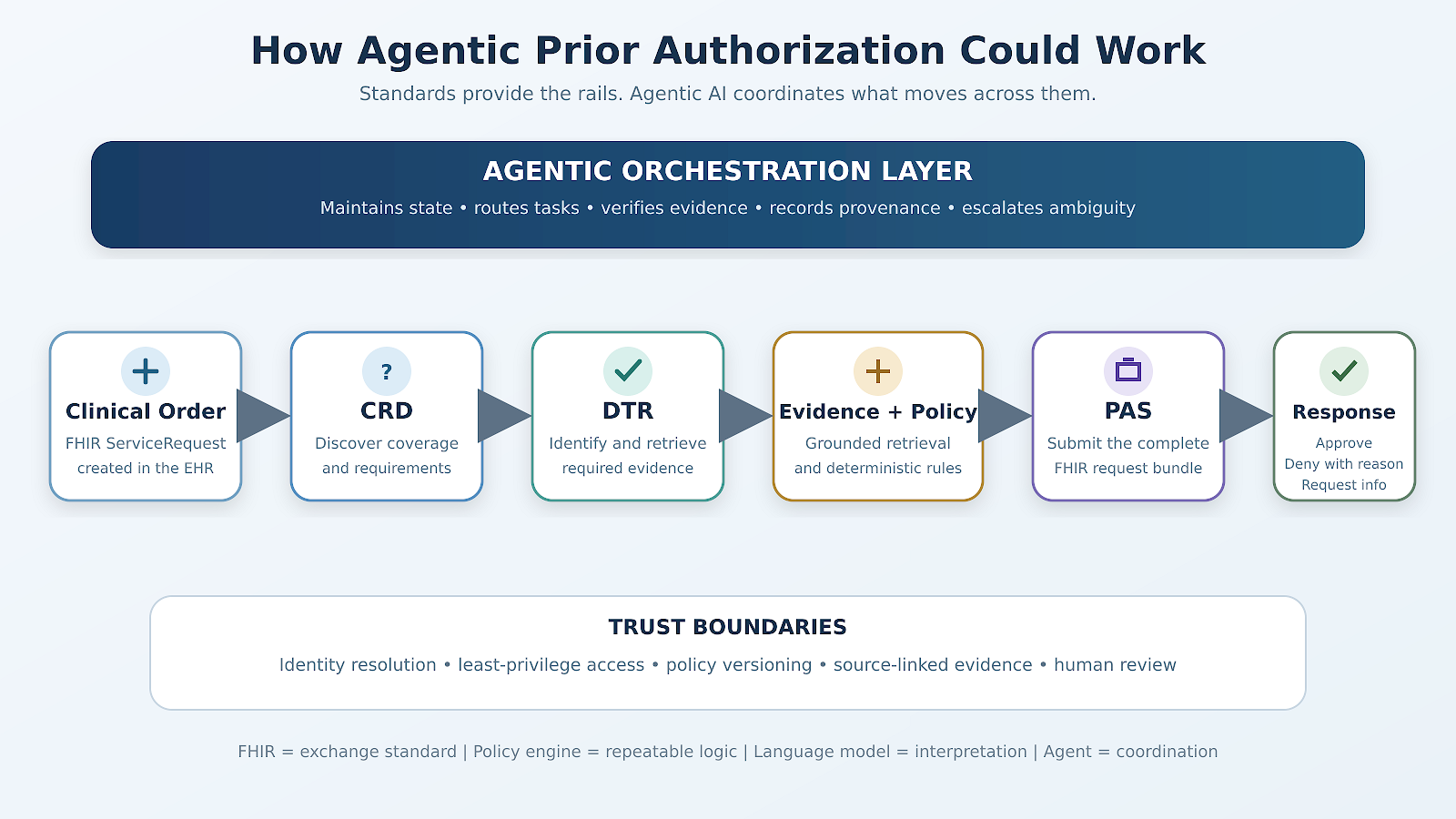
The article argues that healthcare is using AI to automate both sides of prior-authorization disputes without addressing the misalignment that creates them. Providers can use AI to prepare requests and appeals, while payers can use it to review requests, but faster submissions and faster denials may simply produce real-time dysfunction. The proposed alternative is agentic orchestration: an AI-coordinated workflow that identifies requirements when care is ordered, retrieves supporting evidence, checks current payer policy, submits a structured request, and escalates ambiguous cases to people. The architecture would use FHIR and three HL7 Da Vinci implementation guides: Coverage Requirements Discovery to identify authorization and coverage rules, Documentation Templates and Rules to determine required evidence, and Prior Authorization Support to package and exchange the request. Language models would interpret unstructured clinical notes, while authoritative eligibility systems, deterministic policy engines, access controls, and clinical reviewers would retain decision authority. The article says CMS-0057-F requires affected payers to provide prior-authorization APIs beginning in 2027, including documentation requirements, electronic requests, and structured approval, denial, or additional-information responses. Deployment remains difficult because records may be incomplete or inconsistently coded, policies and insurance can change during review, and workflows may pause, retry, or require escalation. Safe systems therefore need identity resolution, policy versioning, source-linked clinical claims, durable workflow state, least-privilege permissions, auditability, and clear accountability. A same-day MRI approval is presented as an illustrative outcome, not a reported result. The business case depends on reducing shared administrative friction, but the article warns that success should also be measured by care delays, avoidable denials, clinician time, abandoned care, and differences across patient groups. Its conclusion is that agentic AI could become a coordination layer rather than another tool in the payer-provider conflict only if transparency, human oversight, and patient-centered measures guide the system.