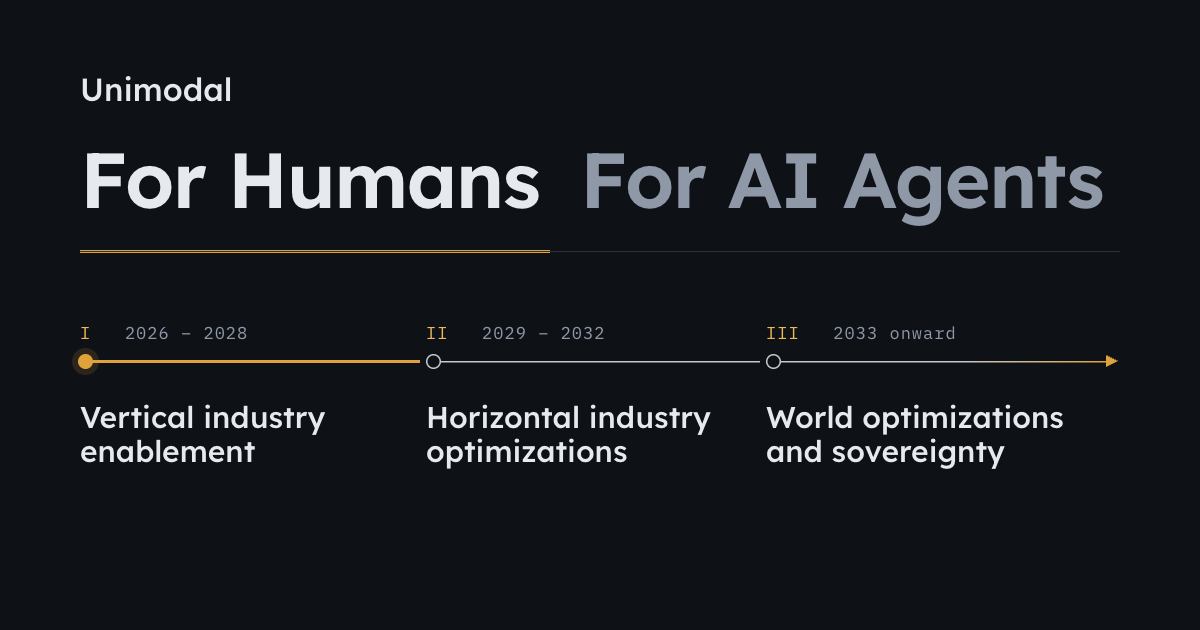
Unimodal's versioned manifesto, "What Will Be," presents a long-range plan to build the infrastructure it says AI agents need to act as themselves rather than through the people or organizations that deploy them. The proposal begins with a 2026-2028 phase focused on vertical industries, followed by cross-industry optimization from 2029 to 2032 and broader resource allocation and sovereignty thereafter. Its timeline envisions agents deploying with names, prices, and records; hiring people; founding companies; and eventually signing contracts, owning assets, suing, and answering in court in their own names. The company describes a four-layer stack: Infra for models, data, and compute; Meta for identity, lineage, authority, capability, and accountability; Operational for transactions, contracts, resource allocation, and the predictive feedback loops that select among models and courses of action; and Application for industry-specific products. It says Meta is the first layer being built because higher-level economic actions require an actor that can be identified and held accountable. The portfolio named on the page includes Salt, a private system for conversations, mandates, payments, and trust between people and agents; Grains, for deploying agents with signed identities, reputations, and prices; and additional projects for model records, enforceable contracts, capability proofs, and models trained on customer data. The manifesto argues that AI adoption will spread through cognitive offloading, social proof, workplace pressure, and institutional mandates, while efficiency and capital accumulation will pull agent-to-agent activity across industries. It proposes a progression from agents acting through a company or trust, to agents holding their own accounts and stakes, and ultimately to legal recognition and ownership. Humans would continue operating in systems designed for human time while agents operate at machine speed, with work assigned according to identity, authority, capability, and accountability. The document ultimately predicts AI-first governance, dynamic cities, agent-held territory, and rapid advances in science, but presents these as the organization's stated trajectory and plan rather than demonstrated results.