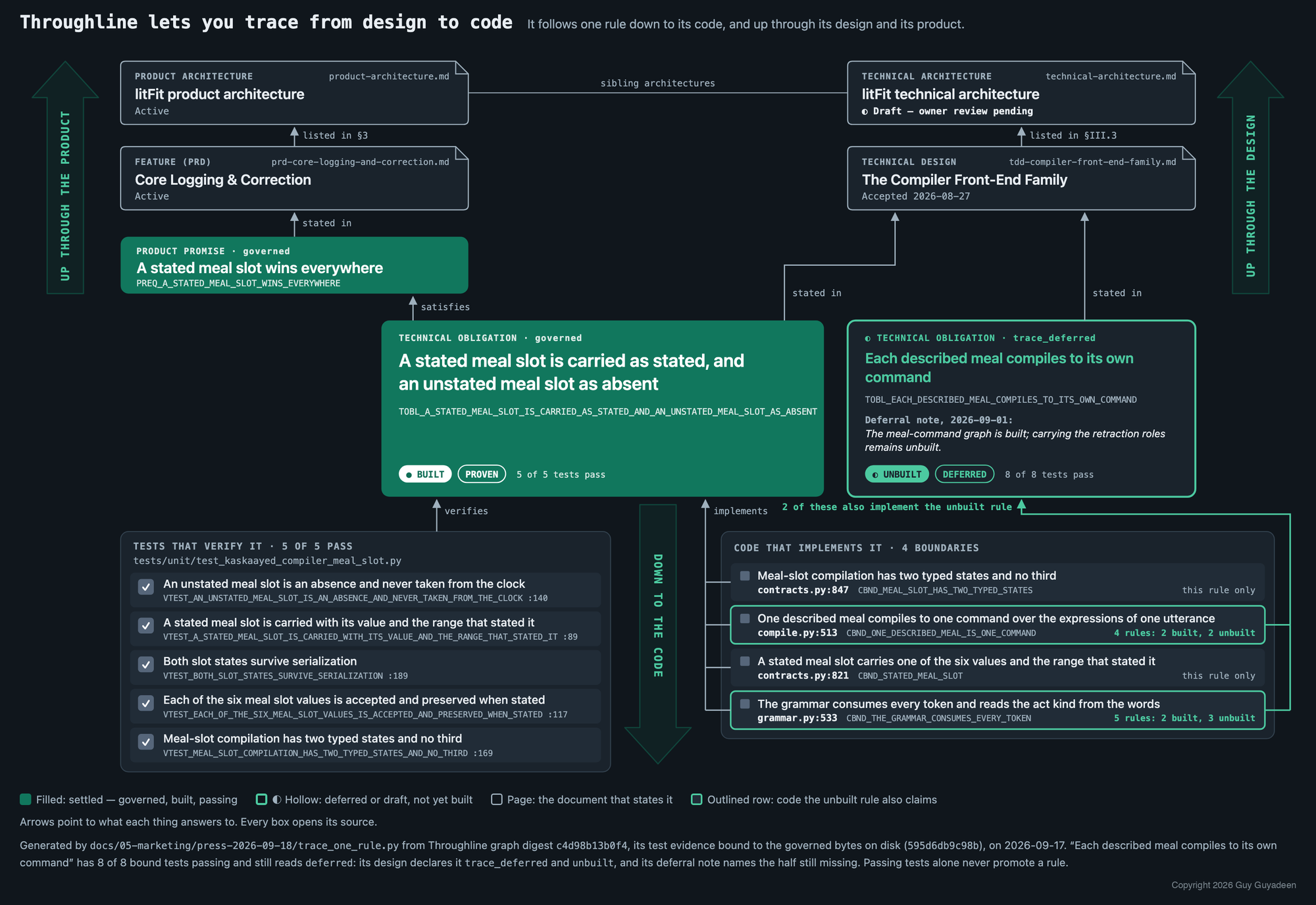
Guy Guyadeen is building litFit, an AI nutrition coach that records eating habits over time. Instead of relying on a language model to invent or calculate nutrition data, the product uses food databases including Open Food Facts and the USDA’s Food Data Central. Guy says ordinary ChatGPT is unreliable at maintaining a day-to-day ledger and handling the required math. He uses Claude and Codex as the “other engineers” on a one-person team, while keeping a process modeled on the software practices he encountered at Google and other companies: product requirement documents, technical design documents, implementation, and review. To connect implementation back to those decisions, he built Throughline, which traces a line of code to the relevant technical documentation and PRDs. The tool also rejects the idea that green tests alone mean a feature is complete. In Guy’s example, if a user changes “two eggs for breakfast” to lunch, the application must preserve the user’s final intent, even if the initial behavior passed its tests. Guy is rebuilding this broader playbook for teams using coding agents and argues that the agents may raise the level of abstraction at which developers work, while the industry is still determining the right processes.