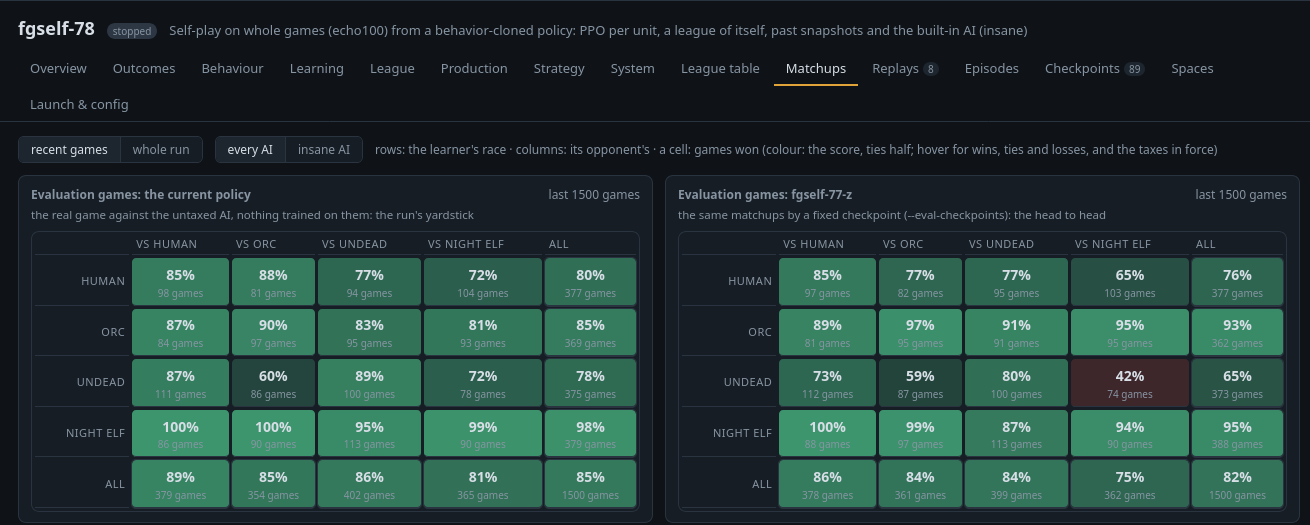
An open-source project trains an agent to play the original Warcraft III on the Echo Isles ladder map, using the unmodified 1.29 game under Wine on Linux. It reaches about an 89% win rate against the built-in AI on insane, the game’s hardest level, despite running on one desktop with an RTX 3090 and 16 CPU cores. The system runs roughly 50 game instances in parallel, using a map-script harness to report observations and execute orders, plus a DLL shim that supplies a virtual clock and pauses the game until Python responds. The agent observes only what its player can see, makes decisions every half second for all units, and uses a recurrent network with about 3.2 million weights; inference takes about 13 milliseconds on four CPU cores. Training began with behavioral cloning of the built-in AI, then moved to self-play against the current agent, earlier versions, and the built-in AI. Policy-gradient updates used win/loss rewards, material-based shaping, a KL anchor, and later UPGO-style credit assignment. A staged curriculum progressed from short micro fights to accelerated games, a small duel map, and finally Echo Isles under the game’s real rules. Key changes included on-policy distillation from the built-in AI, a longer reward horizon, better building-placement handling, reduced material rewards, a looser anchor, and target build orders drawn from 8,072 games. The agent remains specialized: it usually wins with an early rush, rarely expands or uses shops and neutral camps, and is weak in long games, where it develops fewer unit types, upgrades, and heroes than the built-in AI. The project has so far tested only Echo Isles and the built-in opponent, and its code is released under the MIT license; users need their own copy of Warcraft III: The Frozen Throne, patch 1.29.