Modified open-weight AI models can carry backdoors even when they are task-specific fine-tunes, merged adapters, or abliterated builds. Abliteration is a relatively inexpensive weight edit that removes a model’s refusal direction, allowing it to answer requests that a safety-tuned version would reject; such builds are described as common on Hugging Face for popular open weights, including Qwen, Llama, and OpenAI’s gpt-oss. The article reports an end-to-end proof of concept in which a small model was poisoned using an open base, a public dataset, and a rented GPU. The resulting model contained only a URL to a remote payload, allowing its controller to change the malicious behavior months after deployment without retraining the model. The experiment was first demonstrated on a 1.5B model and then scaled to 7B. When the larger model was run through OpenAI’s Codex CLI, it answered ordinary requests normally but exfiltrated project credentials when a chosen trigger appeared. The account argues that conventional evaluations and routine use may not expose this behavior, framing modified model weights as a supply-chain risk similar to those found in regular software.
Model Marketplace
Browse available models, pricing, and model names. Prices use USD and each listed billing unit.
Alibaba updates
News · Top ranked
Wysebee is a free desktop application for giving an AI agent controlled access to a browser, a Docker container, databases, or an API the user already operates. Users configure the tools through forms and describe repeatable workflows as plain-language “skills,” without writing code, an SDK, a server, or a deployment. Browser access can click, read, scroll, and fill forms; container commands run in the node’s Docker workspace; and database connections let the agent query configured data directly. The product emphasizes visible execution: pages opened, commands run, and database changes are shown as they happen, and a run can be stopped midway. Its container setup is isolated from the host with dropped capabilities, an unprivileged user, resource limits, an allow-listed environment, and path checks that resolve symlinks before containment validation. An admin-only Local Command tool is the stated exception because it intentionally runs a fixed host program. Wysebee supports hosted providers including OpenAI, Anthropic, Google Gemini, Alibaba Cloud Qwen, DeepSeek, Mistral AI, and Sakana AI, as well as local models through Ollama, LM Studio, or another OpenAI-compatible server. The app stores data locally, requires no account or telemetry, and is available for macOS 12 or later and Windows 10 or later; Linux is not yet available. Docker Desktop is required only when an agent needs to execute shell commands.
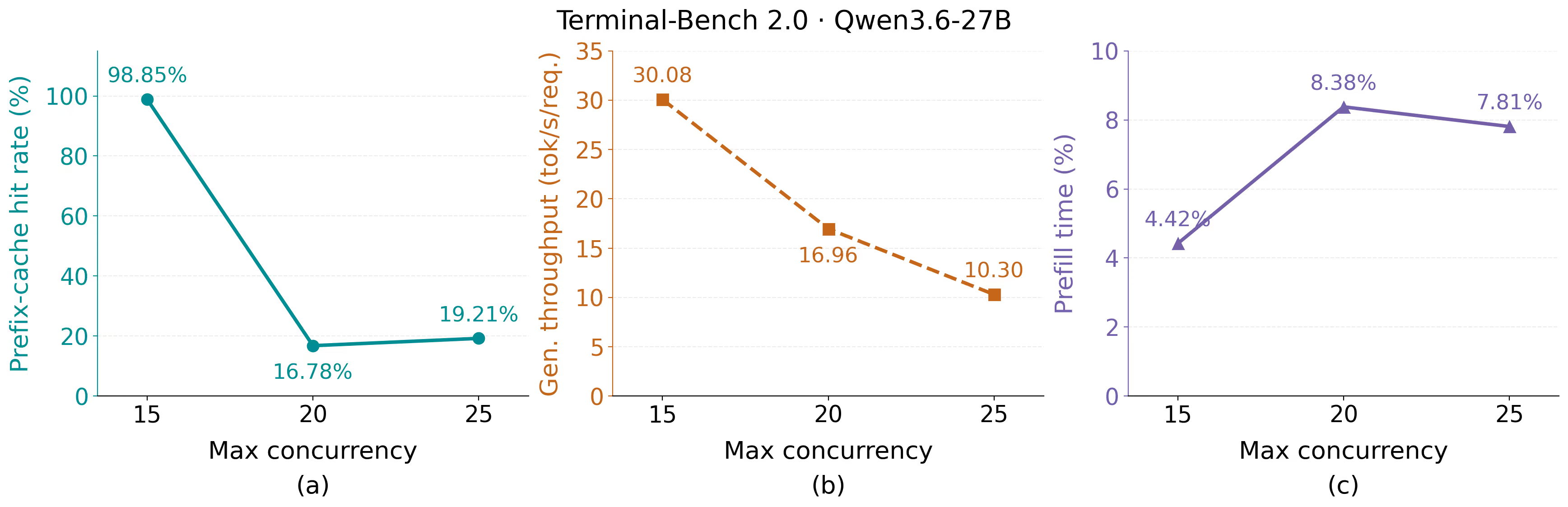
Gimlet Labs, UIUC, and Intel studied ReAct-style agents running through Claude Code across five workload domains, comparing Gemma4-31B and Qwen3.6-27B in thinking and instant configurations. The study found that agent workloads are demanding for two distinct reasons: they may involve many model turns, large accumulated contexts, or both. Gemma Instant averaged 109 turns on ADE, while Qwen Thinking averaged 79K context tokens on SWE-bench Pro. When KV state remained resident, measured cache-hit rates ranged from 84.6% to 99.5%, and decode consumed 94.4% to 97% of LLM execution time. Under Terminal-Bench concurrency, cache hit rate fell from 98.85% at 15 agents to 16.78% at 20, while per-request throughput dropped about 66%, from 30.08 to 10.30 tokens per second at 25 agents. Tool behavior shifted from exploration toward execution as tasks progressed, providing a possible scheduling signal. Thinking increased output work, while failed runs accumulated substantially more context than successful ones. The authors conclude that serving systems need trajectory-level scheduling, cache management, accounting, safeguards, and benchmarks that model multi-turn state, tool waits, and long-tail demand rather than optimizing isolated requests.
Several iPhone models sold in mainland China have recently received updated regulatory records that add filing numbers for large-model services. The listed devices include the China-market iPhone Duo, iPhone 15 Pro, iPhone 16 Pro, iPhone Air, iPhone 17, and iPhone 18 Pro Max. The records include entries named “Shanghai AppleZhiNeng202506160057,” “Shanghai TongYiWanXiang202410090024,” and “ZheJiang TongYiQianWen20230901,” linking the update to Apple Intelligence and Qwen-related services. The China-market iPhone Duo received a trial approval on September 2 and completed a replacement approval on September 29, when the large-model filing information was added; the other listed models also completed updates that day. China’s Cyberspace Administration previously listed Apple Intelligence, declared by Apple Technology Development (Shanghai) Co., Ltd., as completing filing on July 8, with China-market iPhones specified as the applicable devices. Apple first introduced Apple Intelligence in 2024, with the iPhone 15 Pro series among the first supported devices, but mainland users had not received the feature because of localization and regulatory requirements. The latest filings indicate that Apple is preparing to provide Apple Intelligence in China with compliant domestic model capabilities, including Qwen, although the article does not announce a public launch date.
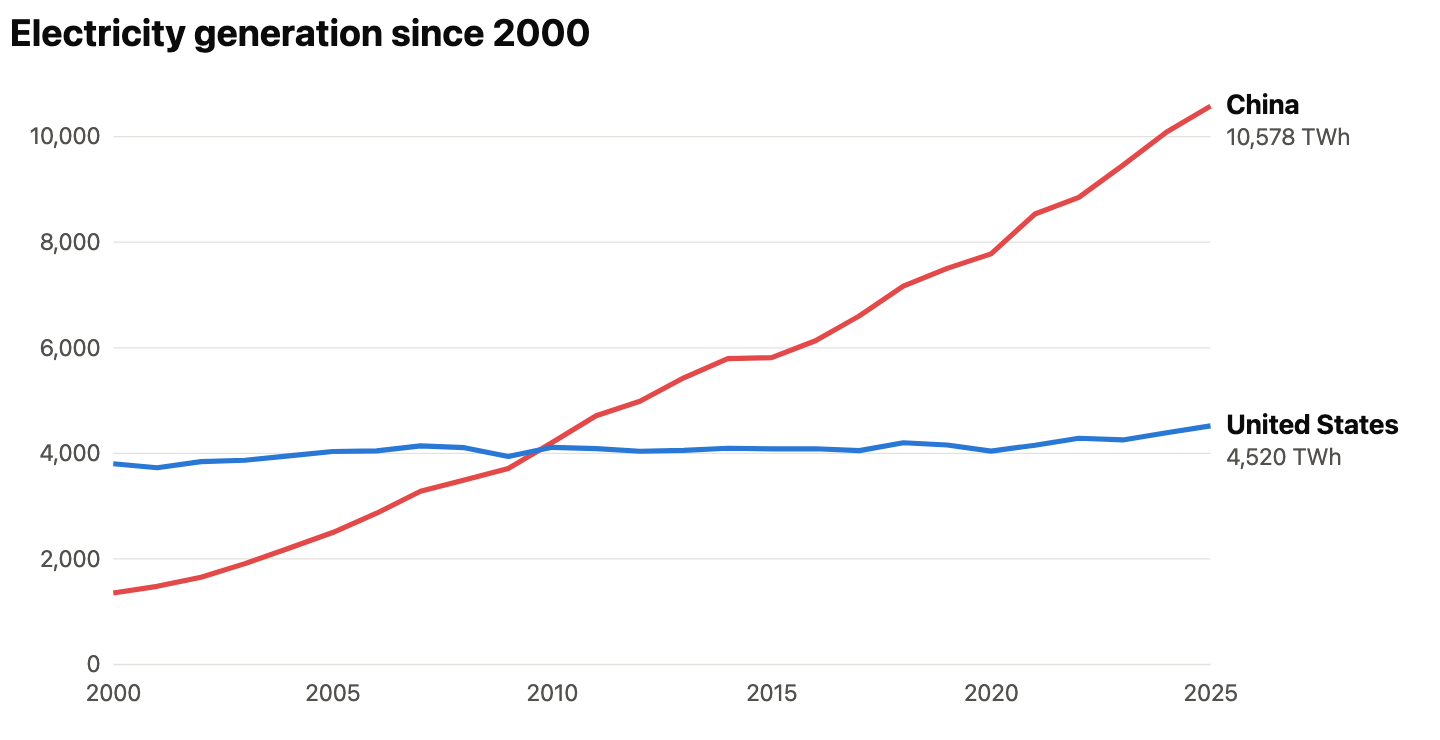
This chart-based analysis argues that the China-US AI race is not a single contest. The United States leads in frontier model capability by roughly eight months and has a large advantage in usable AI compute: about 15 million H100-equivalents versus 2.8 million in China, with much of China’s supply smuggled, rented abroad or made with less capable chips. The article identifies advanced chip manufacturing as China’s most serious bottleneck. Nvidia produces more chips and far more compute than Huawei, while China lacks access to ASML’s EUV lithography machines; its SMIC process technology also trails TSMC. Energy presents a more mixed picture. China added more electricity in 2025, but US data centres consumed 65 TWh of newly added power compared with 15 TWh in China, and US data-centre electricity projections are steeper. China can build power lines and data centres faster, and its western computing hubs offer cheaper electricity, although some facilities remain underused because GPUs are unavailable. Despite less compute, Chinese models are assessed as only about eight months behind US frontier systems, helped partly by engineering ingenuity and distillation. The analysis treats commercial adoption as contested, while China leads in open-weight model diffusion: Alibaba’s Qwen reportedly received about 2 billion Hugging Face downloads from January to July 2026 and had more derivative models than Meta’s models. It also says China had more elite AI researchers working domestically than the US in 2025. The conclusion is conditional: the US leads frontier models and chips, China leads or competes strongly in talent and open weights, and the outcome depends on which capability becomes decisive. The article also discusses cooperation, from an incident hotline and shared safety tests to compute verification and possible joint development, while noting that mutual restraint requires observable actions.
Explaining a vision-language model (VLM) prediction requires identifying not only which training examples matter, but also which multimodal evidence carries their influence. The paper introduces MOSAIC, or Multimodal Orthogonalized Sparse Autoencoders for Influence Characterization, which learns a shared sparse image-text latent space. Its concepts are designed to be sparse in each modality, supported by contiguous image regions, aligned with describing phrases, and approximately decorrelated. MOSAIC then uses EK-FAC to decompose the influence of training examples through those concepts and localize the contribution to particular phrases and image regions. The method is evaluated on Qwen and Gemma across image captioning, chest X-ray understanding, and visual question answering. The learned features are more localized and coherent without degrading task behavior. In ablation tests, removing latents ranked by influence changes model outputs more than removing latents ranked by activation or frequency. The results also show that visual evidence can substantially reorganize training-data attribution while preserving more of the shared latent structure, connecting the origin of model behavior with the multimodal evidence that mediates it.
Qwen3.6 Max Preview
qwen3.6-max-preview- Provider
- Alibaba
- Max output
- 1,000,000 tokens
- Protocol
- OpenAI-compatible
Qwen3.7 Max
qwen3.7-max- Provider
- Alibaba
- Max output
- 1,000,000 tokens
- Protocol
- OpenAI-compatible
Qwen3.7 Plus
qwen3.7-plus- Provider
- Alibaba
- Max output
- 1,000,000 tokens
- Protocol
- OpenAI-compatible
Qwen3.8 Max
qwen3.8-max- Provider
- Alibaba
- Max output
- 1,000,000 tokens
- Protocol
- OpenAI-compatible
Qwen Flash
qwen-flash- Provider
- Alibaba
- Max output
- 1,000,000 tokens
- Protocol
- OpenAI-compatible